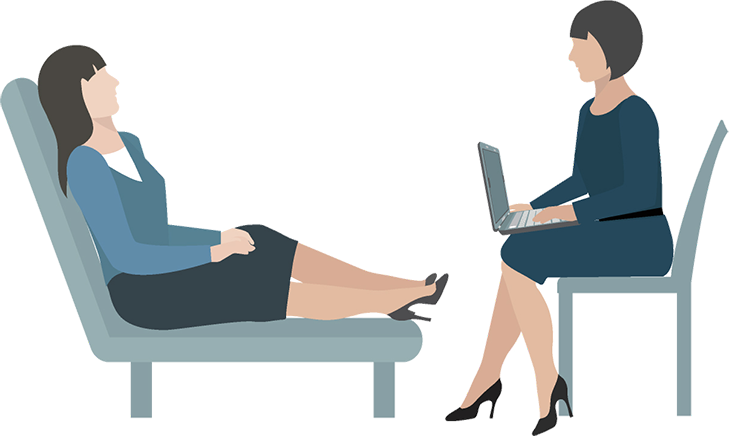
Rashid had always believed in pushing himself as much as possible. He believed strongly in the adage, “No pain, no gain.” Thus, he often found himself missing out on things such as getting enough rest, spending quality time with his loved ones etc. because he was always focused on getting some or the other task done... He would even reserve some of the lighter tasks to finish during his meal times. Even after putting in all this effort, he would often get a feeling of not having done enough. At the end of the day, he would recount his day going through his tasks, and think about the mistakes he made that day and then would start to feel miserable about them. He believed that being harsh with oneself was the only way he would be able to achieve something.
Before we begin...
Think about the last few days and answer:
What are some of the ways in which you have taken care of yourself?
Self-care refers to all the actions we undertake consciously that care for our physical, emotional, spiritual, mental well-being; all the ways in which we take care of ourselves. While this may seem like a simple and an obvious concept, it is more likely that in our everyday lives we spend very little time caring and replenishing.
Which brings us to some commonly held beliefs by students...
It's true that your college life is extremely demanding. Given your academic course, extra-curricular activities and many other challenges that you have to face, it can seem unnecessary and difficult to prioritize self-care. But this is exactly what makes self-care all the more important. Think of it as simple things that you can do to help recharge your own batteries!
Self-care gives us energy, helps us be better equipped and have more resources at our disposal. There will always be a new assignment to complete, an upcoming test, an event or any other demand. But consciously creating time for yourself (even if that’s just a dedicated 15-20 minutes of your day) can help you feel more balanced throughout your four years. Plus, you’re less likely to feel burnt out and be much more productive in your remaining time.
When it comes to being productive and efficient, many students believe that doing more, resting less is what produces results. While it may help in the short run, being unfairly harsh towards ourselves and not meeting our needs can have other negative effects. By practicing self-care, you can achieve the same (if not better) results while also not depleting yourself.
Additionally, self-care is known to help reduce stress, an important part of emotional and physical health, and necessary for our relationship with ourselves and in turn, with others.
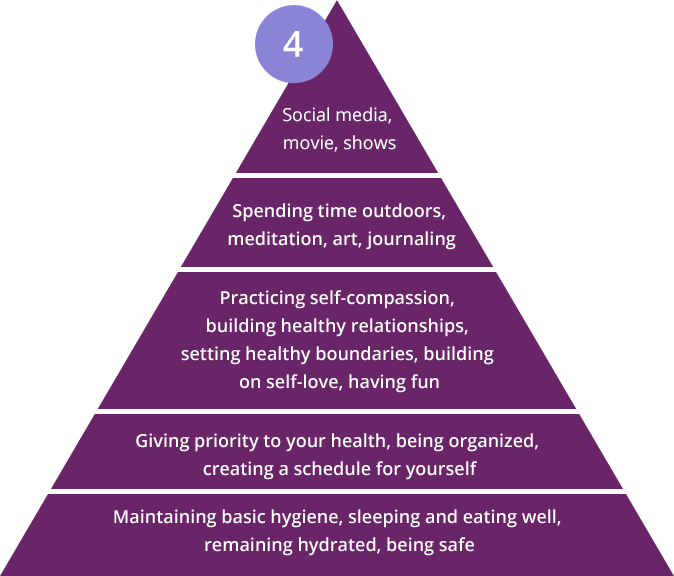
(Based on the Hierarchy of Self-Care by Whitney Goodman)
This pyramid shows the hierarchy of self-care; the ones at the bottom are more fundamental to our wellbeing, while the ones toward the top aim to enrich our well-being further. Thus, self-care isn’t just about fancy meals, visiting a spa or getting an expensive gym membership. It is about recognizing what our needs are, and effectively addressing them.
For one person, it could be something as simple as getting enough sleep, or taking a walk around the campus, while for another it could mean not being too hard on themselves after making a mistake/ not scoring as much as they would have liked to. For some it could be setting boundaries in relationships, or taking a break (it’s as much about things that you don’t want to do). It’s essential to remember that these activities are not just benefitting in the short run but also contribute to your long-term well-being (binge eating or watching an entire season of your current favorite show isn’t necessarily self-care).
| Connecting with friends | Exercise | Setting boundaries with people |
| Reaching out for support | Meditation | Journaling |
| Disconnecting from social media | Reading for leisure | Any spiritual practice |
| Taking a walk | Sports | Maintaining a schedule |
| Yoga | Spending time outdoors | Sleeping, eating well |
Things I can do to feel more connected:
Things I can do if I am feeling overwhelmed:
Things I can do to be physically active:
Things I can do to feel physically relaxed:
Things I can do to center myself:
Things I can do to express my emotions:
Things I can do to soothe myself emotionally:
Things I can do to stimulate myself intellectually:
Things I can do to take a break from intellectual stimulation:
Things I can do to center myself:
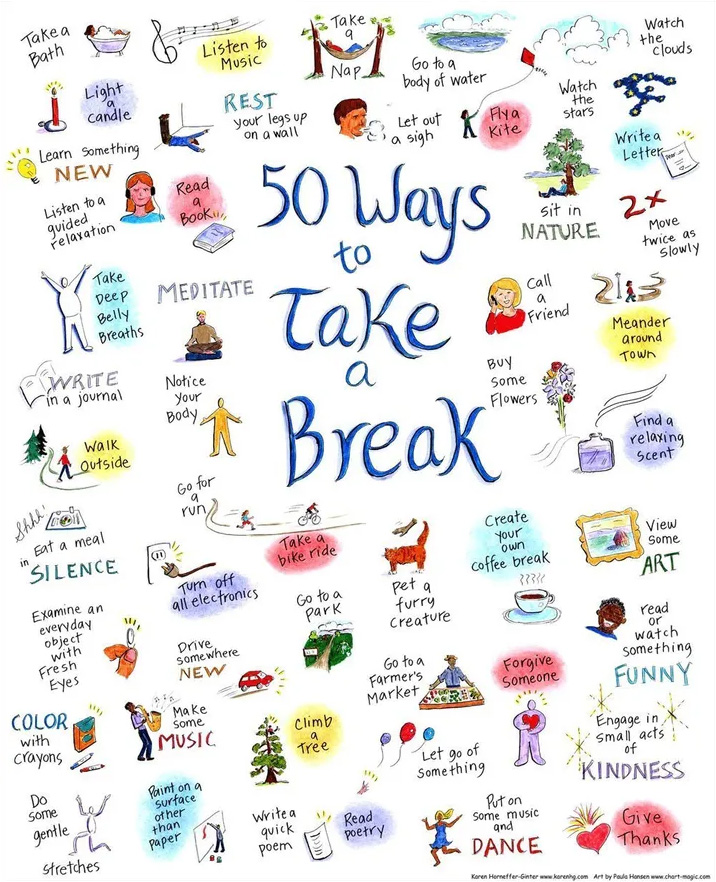
'50 Ways to Take a Break' by Karen Horneffer-Ginter