
Trisha had always been good at academics and had achieved her dream of getting into IIT-B. While she knew it would be hard work, the constant assignments and deadlines, and the range of activities on campus that she could take part in had left her feeling overwhelmed. She would constantly feel torn between her personal and academic commitments and was stressed about where to start!
Rahul was experiencing something similar. Although he had been putting in a lot of work, he felt like he just wasn’t progressing enough. At any given point, there were so many things left to do! He often felt lost, like there was no sense of direction.
InitiationJuggling and managing various things at once can indeed be difficult. Sometimes, taking a step back and just prioritizing and setting goals can be helpful.
Setting goals helps build a road map of sorts and provides a sense of direction for our actions. The most effective performance is linked to having specific, difficult but attainable goals to which individuals are committed (Lunenburg, 2011).


All of us have a set number of hours. The best way to utilize time and accomplish the many things we want to is to first prioritize our goals. A useful tool for the same is Covey's time management matrix. The quadrants are based on two main factors- important (tasks that are important and contribute to our goals) and urgent (tasks that need immediate attention) and allow us to categorize our tasks and prioritize which task needs to be done first.
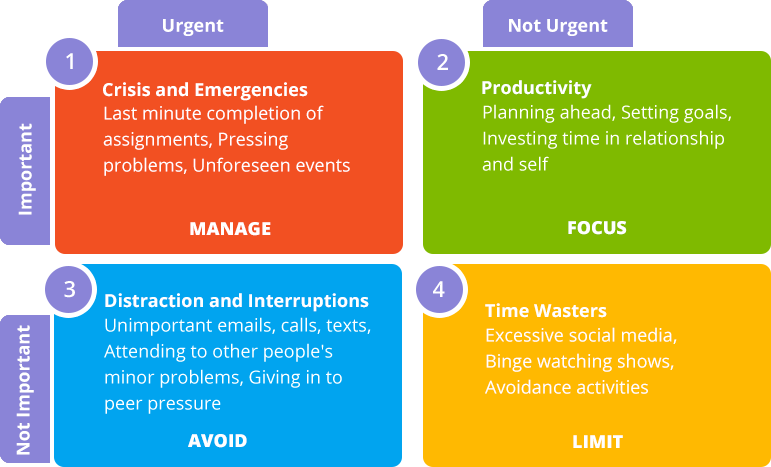
It’s important to identify where we are currently spending our time, where it would be more helpful and adjust our schedule accordingly. Spending more time and energy on the activities that will actually produce long-term results, and not only ones that will produce results in the short-run are essential
(Find more on Time Management)

A commonly used acronym for setting goals is 'SMART' goals.
Specific: The goal must be well defined and it must be clear what action you have to take. A specific goal is more likely to be accomplished than a general and vague one. Example: "I have to study Chemistry's chapter 11 today" as opposed to "I have to study today".
Measurable: Your goal must have a clearly established criterion that will help you monitor progress. Making your goals specific will make it easier to measure them. Example: "I will learn 100 new words every week" as opposed to "I will learn a new language"
Attainable: Select optimum level goals. Goals should be challenging but not overwhelming and must be achievable with sustained effort. Example: If your aim is to work on your fitness, your starting goal can be "walking 1/2km" instead of "jogging 10 kms"
Relevant: Ensure that your goals are aligned with your personal values. You are more likely to work towards goals that resonate with you personally and are in line with your long-term vision. Example: Aiming for an internship that holds value for you (because of the skills and knowledge you will gain) as opposed to aiming for an internship simply because everyone else is aiming for it (although it is not the best fit for you)
Time-bound: The goal must have a timeline with a clear beginning and end date. Without a timeframe, there is no sense of urgency. Example: "I am going to finish reading one chapter every two days" as opposed to "I want to finish reading this book"
Using positive, clear and simple language while writing your goals is helpful.
It can be beneficial to set process-oriented goals in place of those that are results oriented. Having goals that are something you can control and act upon are more beneficial as opposed to those that depend on outcomes and other individuals. E.g. 'Study regularly for x no. of hours' instead of 'score x marks'
Aligning your environment with your goal and using visual cues to track progress can also be useful. Put up posters, mark your calendars, create streaks, take things off a to-do list, find whatever works for you.